

A LAYMAN NURSE-OBSERVER
ORTHODOX HEALING & WONDER
ON DESPERATION & DIVINE WARMTH
The Fire on the Afterdeck
When the cry for warmth becomes the cry of the soul
Thirty-four years ago, on a night I cannot forget, our Coast Guard crew was searching the North Atlantic for fishermen who were overdue. Pancake ice. Sleet. Swells that rolled in with a cold indifference only the sea can manage. And then we saw it: fire. Not a flare. Not a signal mirror. A fire on the afterdeck, burning out of control, with the crew still aboard. They had not lit it to call us. They had lit it because they were cold. Beyond hope of rescue, beyond signaling, beyond strategy, they had simply done the most human thing imaginable: they reached for warmth.
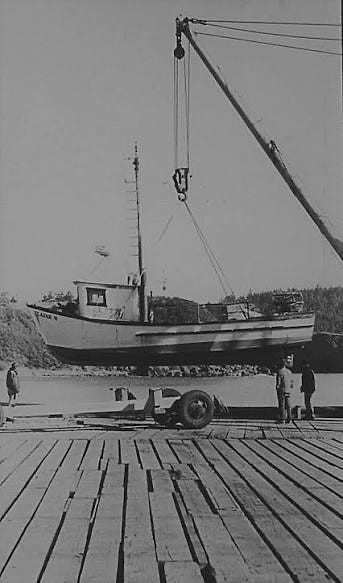
The fire got away from them, of course. We had to fight both the flame and the rising water before we could bring those men home. But here is the thing that has never left me: we found them because of the fire. Their act of raw, shivering desperation, and not their competence or their seamanship or their distress flares, became the very thing that saved them. I have been a nurse for many years since that night, and I have watched people teeter at the edge of their endurance in many different ways. But I keep returning to those fishermen. Something in their story feels like a parable. Something in it feels Orthodox.
✦ ✦ ✦
"Out of the depths I cry to you, O Lord! O Lord, hear my voice! Let your ears be attentive to the voice of my pleas for mercy."
PSALM 130:1–2 · DE PROFUNDIS
The Church has always known that de profundis, "out of the depths," is not a failure of faith. It is, in a way, the purest form of prayer. Psalm 130 has accompanied the Orthodox faithful at Vespers and at the burial of the dead for centuries precisely because the Church does not flinch from the depths. She has watched her saints go down into them. She has buried her martyrs from them. And she knows that the cry which rises from the very bottom, wordless and desperate and bodily, is not too small or too broken for God to hear.
Those fishermen could not send a proper distress call. Their radio may have failed; their hope certainly had. What they had left was only this: a body's refusal to be cold. And so they built their fire. I wonder sometimes whether our prayers, when they are most honest, look very much like that fire on the afterdeck: improvised, a little dangerous, out of control, and made of whatever was left at hand.
FROM THE DESERT
❧
"This is the great work of a man: always to take the blame for his own sins before God and to expect temptation to his last breath."
ABBA MACARIUS THE GREAT · SAYINGS OF THE DESERT FATHERS
Abba Macarius does not describe the spiritual life as a staircase we ascend in orderly fashion. He describes it as a vigil, a waiting in acknowledged weakness, right up to the last breath. The Desert Fathers were not romantics about suffering. They knew exhaustion. They knew the cold of the Scetic desert at night, the heat of its day, the long watches in which nothing seemed to happen and God seemed very far away. And their counsel was not, "be stronger." It was something closer to: stay. Stay in your weakness. Expect the trial. Do not be surprised that the fire is getting away from you.
This is the thing that has always quietly undone me about Orthodoxy: the Church does not ask us to pretend we are not cold. She does not offer us a spirituality of pure composure. She gives us the Psalter, all 150 of them, including the ones where the Psalmist accuses God of hiding His face. She gives us the prayer of Gethsemane. She gives us Holy Saturday. She knows that before the Resurrection there is the tomb, and before the tomb there is the cry, My God, my God, why hast Thou forsaken me,which is perhaps the most desperate fire ever set on the afterdeck of human history. And yet. And yet that cry was not the end of the story.
THE DENOUEMENT
We brought the fishermen home. Towed what was left of their boat to the lift at the dock. They went to their families and their beds, and I went back to watch. That is what a search and rescue crew does. And that, I have come to believe, is something of what God does: not waiting for us to send the proper signal, not requiring that our prayer be formal or our faith be composed, but watching the darkness for any light at all, however desperate, however out of control.
If you find yourself in the kind of cold that has moved past strategy and into mere survival, if your prayer has become more of a fire on the afterdeck than a polished petition, I would gently suggest that you are not outside the reach of grace. You may, in fact, be exactly where the Psalms have always found the faithful: in the depths, crying out. The Church has prayers for that. She has saints who know that place. And she has, in the Holy Mysteries, a warmth that is not our own.
A word to the reader: I write as a layman and a nurse-observer, not as a theologian or a guide. If any of this stirs something in you, a memory of your own cold night or a question about desperation and prayer, I encourage you warmly to bring it to your priest. He has been given what I have not: the authority to accompany you into those depths, and the sacramental means to meet you there.
✦
ORTHODOX HEALING & WONDER · WRITTEN WITH THE BLESSING OF MY PRIEST